Tea facts and other useful tea related information


[AddThis. Add Wan Ling Tea House (Europe) to your favourities and other sites such as Del.icio.us, MySpace, Reddit, Digg, Google and Facebook.]

[Pay Pal Fast Checkout - Safe, Secure and Reliable. Buy quality tea with confidence at Wan Ling Tea House.]
[Google Checkout - Safe, Secure and Reliable. Buy quality tea with confidence at Wan Ling Tea House.]

China Tea Facts

China Tea Facts

China's cultural and geographical diversity means that there are a seemingly endless range of tea varieties.

One of the striking aspects of China's tea industry is that almost all the tea, unlike India, Africa or Sri Lanka, produced is consumed by the internal market. May be because of the 2000+ years of tea history, tea is an fundamental part of daily life for rich and poor alike.

Here we will take a look at some of the key regions behind some of the teas we enjoy. Due to the range of teas from FuJian and YunNan we have set up dedicated tea facts pages.
Others are included here: ZheJiang, JiangSu, AnHui, JiangXi & TaiWan.

ZheJiang

Located in the East of China, bordering Shanghai and the other well know tea producing provinces of Fujian & AnHui. Zhe Jiang is Chinese largest tea producer by output, area given to production and also export.

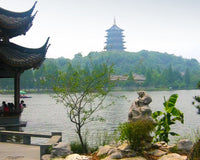
Zhejiang's capital is the renowned city of HangZhou, which is also home of the Chinese national tea museum and the famous West Lake (Xi Hu).

The majority of Zhejiang's tea production is given over to green teas such as Long Jing (Dragon Well), though An Ji white tea is another famous Zhejiang tea. The best Long Jing teas should be prepared using water from Hu pao quan or Running Tiger Spring.

The Long-Quan kilns of Zhe-Jiang province, have been producing much sort after ceramics since the early part of BEI-SONG (Northern Song 960-1127AD) period. It was during the NAN-SONG (Southern Song 1127-1279AD) period that the kilns reached a most glorious period and their output increased alongside their quality. It is said that when you have the opportunity to look upon these ceramics and touch them, the sensation is like that of jade.

JiangSu

JiangSu is located in the Eastern part of China, bordering Zhejiang, Anhui and ShanDong.

One of JiangSu's most famous teas is Bi Luo Chun (green snail spring), a green tea produced near Dong Ting Lake. Another name for this tea was Xia Sha Ren Xiang or deadly fragrant tea! Because of this tea's amazing fragrance it was given as a Tribute Tea to the emperor, who although loved the tea was not so impressed with its name! The emperor renamed the tea Bi Luo Chun, as it is a spring tea and the shape of the curled tea leaves reminded him of a snail.

Yang Xian tea was a classic tea during the Tang dynasty (618-907) of JiangSu. The tea was made famous by the founding father of tea, Lu Yu, a JiangSu native, and his 'Classic of Tea'. Such reference meant that it was not long before the emperor requested that a Tribute of Yang Xian be sent to his court, further ensuring that remained a famous tea.

JiangSu's legacy to tea reaches beyond its range of fine tea through its tea pots and in particular the zi sha clay or sand from the surrounding hills of YiXing. In tribute to JiangSu's classic products of Yi Xing zi sha and Yang Xian tea, a number of people refer to some tea pots as Yang Xing.

AnHui

AnHui is home to famous teas such as Mao Feng green tea and Qi Hong or Qi Men hong cha or red tea, known in the west as Keemun black tea. Qi Men was one of the original black teas that started the tea craze in Europe. Today, almost all Qi Men black tea is exported, this often means finding it is China is quite difficult.

Mao Feng and Mao Jian green teas typically come from the regions around Huang Shan, the 'Yellow Mountains' and Qi Men. One of the largest markets for the Huang Shan Mao Feng can be found in the town of She Xian. From here the teas are distributed around China.

The town of Tai Ping home of the beautiful long green tea leaves of Tai Ping Hou Kui is also located in An Hui.

JiangXi

Zhu ye qing is a well known green tea from JiangXi however the province's most famous association with tea and its consumption is probably Jing De Zhen. Jing De Zhen is a city county in JiangXi, is the home of the world famous porcelains that have been exported throughout the world, especially during the Qing and Ming dynasties. The fine porcelain of the region, along with the skilled artisans has captured hearts of many and as with other Chinese arts has been combined with a practical usages. The tea sets and tea cups of Jing De Zhen can be found as pure white porcelain or hand finished in a wonderful range of designs.

TaiWan

Often called Formosa, the name given it by Portuguese traders, meaning "beautiful island." The majority of Taiwan's tea production is oolong. Taiwan's population is closely related to that of sea faring Min Nan people of China's Fujian province. Famous Taiwan Oolong's or Formosa Oolong's include Gao Shan Oolong (Tall mountain oolong), Dong Ding Oolong and Bao Zhong (Pou Chong).

In the early years of its economic growth, much of Taiwan's tea was exported to the mainland. However, recent economic prosperity had produced a local population with a taste for some very refined oolongs. This includes an increasing production of quality organic teas. Presently, only about two percent of the island's famous teas are exported. These fall into three categories: fuller oxidised dark oolongs, jade oolongs, and the lightly oxidised, almost-green pouchong tea.